For Australian advisers, paraplanners & licensees

Advice that shows its working. End to end.

AdviceGenie takes a case from “I have a client who needs advice” to a researched, modelled, checked and approved Statement of Advice. Every product claim cites the PDS page it came from, every recommendation waits for your decision, and every step lands in the audit trail.

  • Designed for Australian hosting (Sydney)
  • The AI proposes, the adviser decides
  • Every claim traced to its source page
AdviceGenie practice dashboard: the advice value chain from unstructured product documents to an evidence-backed SOA, with 10 active clients, 14 active cases and 248 products under product intelligence
The client portal on a phone: “Your Statement of Advice is ready”, retirement age 62, target income $85,000
The problem

Advice takes too long to produce — so too few people get it.

Most of the hours behind a Statement of Advice aren't spent on judgement. They go on re-keying fact finds, reading product disclosure statements, reconciling fee tables and checking that page 40 still agrees with page 4. The cost of that work sets a minimum fee, and every client below it is turned away.

23.9 hrs

to produce advice for one client, end to end.

FSC, White Paper on Financial Advice

~15,500

registered advisers, down from about 28,000 before the Royal Commission.

ASIC Financial Advisers Register, Mar 2025

133.6

clients per adviser on average. Capacity can't grow by working longer hours.

Iress Advisely Index, Nov 2024

$37k–84k

in mandatory costs per adviser each year, before a single client is served.

Adviser Ratings, 2026

David Karunaratne, founder of AdviceGenie
Why we built it

Not “AI that writes SOAs”. An intelligence layer between raw product documents and professional advice.

Drafting tools speed up one stage of the advice process and leave the rest alone. The fact find is still re-keyed, the product research is still done PDF by PDF, and nobody can say which clients are affected when a PDS changes.

AdviceGenie structures the product layer first: PDS and TMD documents become versioned, searchable data with page references. Everything downstream — research, comparison, recommendation, SOA and compliance — inherits that discipline, and the adviser stays in charge of every decision.

David Karunaratne Founder · Tech & AI evangelist · 25+ years in Australian financial services LinkedIn
How it works

One case. One controlled chain. Every step on the record.

Six layers share the same structured data, so nothing is copied between tools and nothing drifts out of date. Thirteen specialised agents do the groundwork. You make the calls.

01 · CLIENT

Fact find, verified

A digital fact find and document extraction, with the source, date and verification state recorded against every field.

02 · STRATEGY

Model the options

A real projection engine with versioned calculators and a declared assumption set. Change one lever and every figure moves together.

03 · PRODUCTS

Search the APL

Plain-English search over structured product data. The rules engine shows every exclusion, the rule that caused it and the value that failed.

04 · RECOMMEND

Evidence, then decision

Recommendations carry page-level PDS evidence and the alternatives considered. Approve, modify or reject; modifying or rejecting needs a reason.

05 · CHECK

Compliance & consistency

Checks say whether they're AI checks, adviser reviews or licensee approvals. A consistency agent compares every stage with every other.

06 · DELIVER

SOA and client portal

A versioned SOA with adviser and licensee sign-off, plus a plain-language digital version the client reads on any device.

APL Intelligence · Ingestion

From a 154-page PDS to structured, versioned product data.

Every product document runs through an eight-stage pipeline: received, processed, identified, extracted, validated, versioned, compared with the prior version and published. Fields the model is unsure of go to a person before anything is published.

  • Fees, options, insurance terms and eligibility extracted into a structured profile
  • Low-confidence fields flagged for adviser review before publishing
  • Prior versions kept, so you can see what was true on the advice date
Ingestion pipeline: one PDS, end to end, published 27 minutes after it arrived.
Product intelligence

A product is a record you can reason over, not a PDF.

Each product carries its structured profile, its PDS and TMD versions, its change history and every piece of evidence behind it. The agents read this layer through defined tools, never the raw document.

  • APL status, PDS version and effective date on every product
  • Investment menu with growth/defensive split and option fees
  • A knowledge graph that links products to the clients who hold them
Structured product profile, with its PDS and TMD versions.
APL search

See why products were excluded, not just which ones made the list.

Ask in plain English. AdviceGenie turns the question into explicit criteria, searches the whole approved product list and records the rule and the failing value for every exclusion.

248products searched
40in scope
31excluded, with reasons
9shortlisted

From the demo's Margaret Henderson case. The biggest exclusion group comes from the preservation-age rule: she is 58, so no pension-phase product is open to her yet.

Natural-language query → structured criteria → ranked shortlist.
Change centre

When a PDS changes, see which clients it affects.

Searching documents can tell you what a PDS says. Only a versioned product layer can tell you which live recommendations relied on the clause that just changed, and which advisers need to know.

  • Field-level differences between PDS versions, each rated favourable, material or adverse
  • Impact traced to advice cases, live recommendations, advisers and clients
  • Review work opened and tracked until it is closed
An adverse TPD definition change, traced to seven advice cases.
Advice intelligence

Modelling you can defend, line by line.

Scenarios differ only in the lever they're named for. Each line comes from a versioned calculator run against a declared assumption set, and none of the figures is typed in by hand.

  • Retirement projection, insurance needs and cost-benefit calculators, all versioned
  • Assumptions and simplifications stated, not hidden
  • Every chart also available as a table
Four scenarios from one projection engine, labelled directly on the chart.
Adviser approval

Nothing reaches the SOA without your decision.

Each recommendation shows its reasoning, evidence and warnings. You approve, modify or reject it, and a modification or rejection needs a reason, which goes into the audit trail.

  • Page-level PDS evidence attached to every recommendation
  • Alternatives listed, with reasons they weren't chosen
  • Cost disclosed, even when the recommended product isn't the cheapest
The AI proposes. The adviser decides, and the reason is recorded.
Compliance

Every check says who has to decide.

Every compliance result is labelled as an automated AI check, a matter for the adviser's professional judgement, or a licensee sign-off. AdviceGenie doesn't claim to certify that advice is lawful. It reports what it could check and names who decides the rest.

  • Best Interests Duty, suitability, scope, fees and disclosure checks
  • Each finding links to the evidence it relied on
  • Warnings kept separate from items that need review
Three-tier attribution: AI check, adviser review, licensee approval.
Consistency agent

Catches the hand edit that nobody noticed.

The fact find, strategy, calculations, products and SOA are all the same structured data, so the platform can compare them field by field. In the demo, a draft SOA says retirement at 65 while every other stage says 62, and the check fails.

  • 23 assertions compared across every stage of the case
  • Run against any SOA version, draft or final
  • The kind of error a document-generation tool can't see
Draft v2 fails: the SOA disagrees with the fact find on retirement age.
Statement of Advice

Versioned SOAs with the source of every section.

Each section records where it came from: structured data, a licensee template or model-written text. Versions are compared side by side, and a final SOA carries both the adviser's and the licensee's approval.

  • Draft → final version history, with the reason for each change
  • Implementation steps ordered so existing cover isn't cancelled early
  • Adviser and licensee sign-off, time-stamped
Final SOA with adviser and licensee approval, and the source of each section.
Client experience

Your client gets their advice — and nothing else.

A plain-language digital SOA that reads well on a phone. It shows the client's goals, where they stand, what you recommend and why. Your file notes and the platform's reasoning are not part of it.

Client portal home: the Statement of Advice is ready, retirement age 62, target income $85,000, plan lasts to age 90

A welcome that gets straight to the point

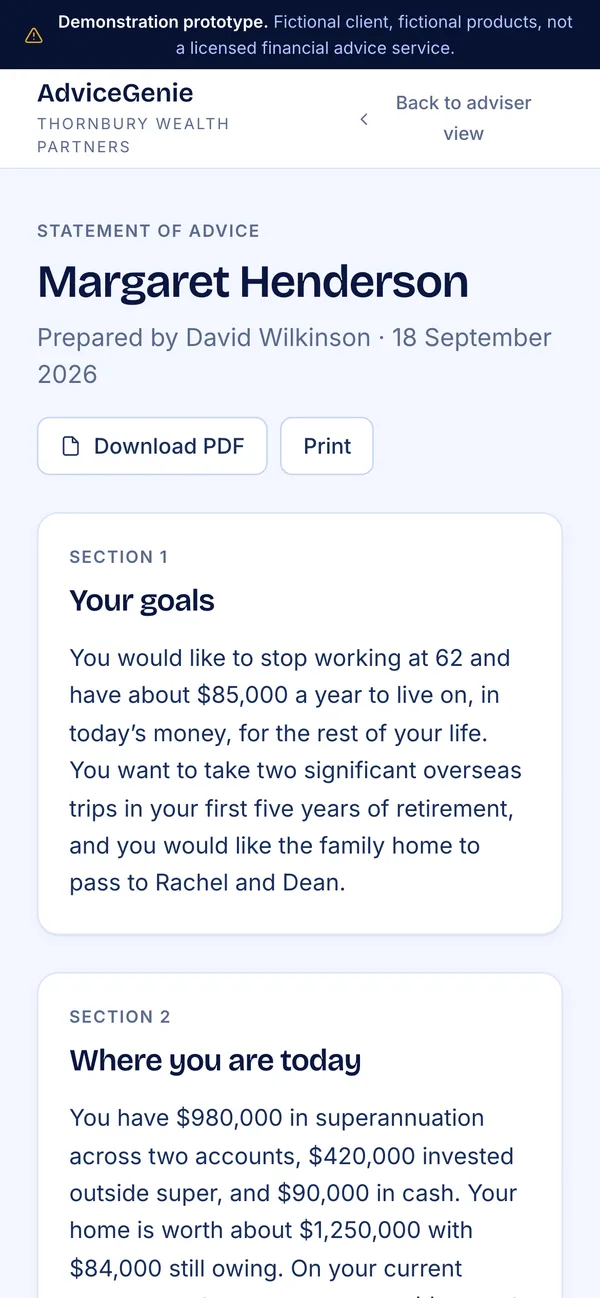
The client's digital Statement of Advice in plain language, section by section

The SOA in plain language

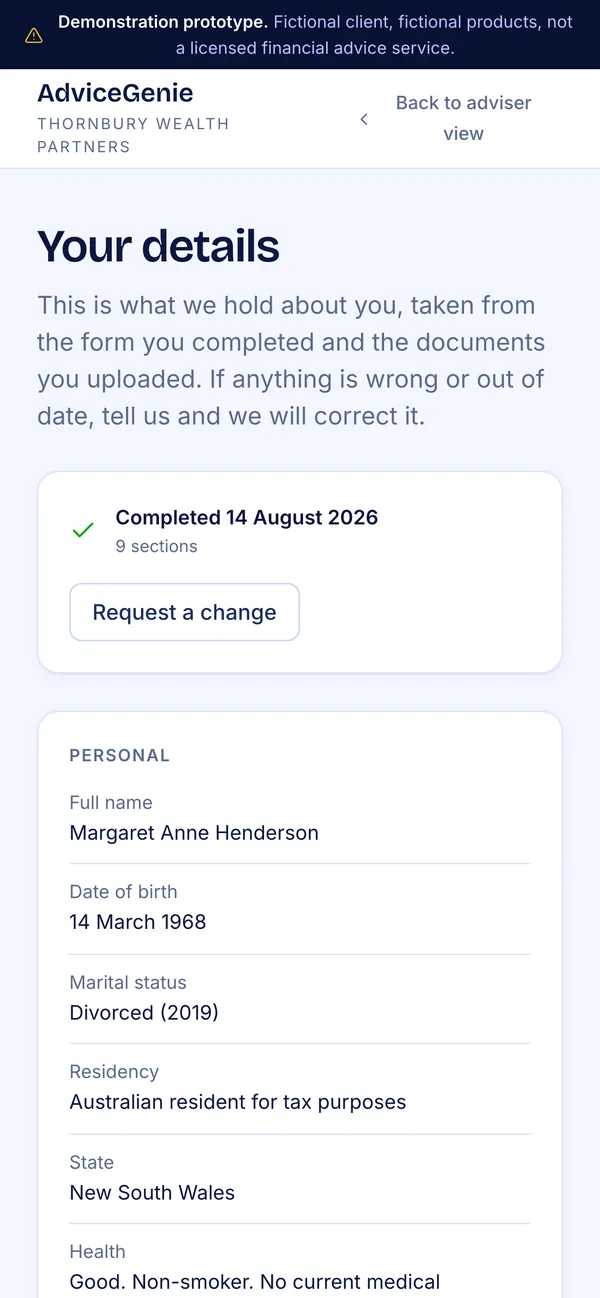
The client's details as held on file, for the client to review

Their details, for them to confirm

Security & privacy

Built for the most sensitive file in the practice.

Advice files hold tax returns, health disclosures, balances and family details. We treat security as part of the design, not something added later. Some protections are visible in the demo today; others describe how the production platform is built.

Controls you can see in the demo

Try them at /demo/

The client view is built by allow-list

The client's data is built by selecting what they should see, not by hiding the rest. Adviser notes, AI reasoning, exclusion logs and compliance findings aren't in it at all.

A human signs off every decision

The AI can't finalise advice. Every recommendation needs an adviser decision with a reason, and release to the client needs licensee approval.

Agents only use approved tools

Each of the thirteen agents is limited to named tools and records what it used. None reads arbitrary documents, so its answers can be reproduced and checked.

One audit trail for everything

Client updates, document ingestion, agent actions, calculator runs, exclusions, overrides, SOA versions and sign-offs are recorded in one attributed timeline.

Versions, never overwrites

PDS versions, assumption sets, calculators and SOA drafts are kept rather than replaced, so you can show what was true on the day the advice was given.

A demo with nothing to leak

Every client, provider and product in the demo is fictional, and it runs entirely in your browser. Nothing you type is sent to a server.

How the production platform is built

Architecture · in build

Hosted in Australia

Designed to run in AWS Asia Pacific (Sydney). Client records, documents and the audit store stay onshore.

AI inference in Australia

Models run through Amazon Bedrock on an Australian inference profile. Client data isn't used to train the underlying models.

Encrypted in transit and at rest

TLS for every connection. Records and documents encrypted at rest with AWS KMS, and documents served only through short-lived private links.

Roles enforced on the server

Adviser, paraplanner, licensee and client permissions are checked in the API. Users can't grant themselves a higher role, and a suspended account stops working on its next request.

Each practice's data kept separate

Every record is scoped to its practice and licensee, and access is resolved from the signed-in identity, never from a value in the request.

Built around the Privacy Act

Designed around the Australian Privacy Principles: collect only what the advice needs, show clients what is held about them, and keep records for as long as the law requires.

Audit trail

A decision you didn't take is still on the record.

  • Filter by AI agent, adviser, client, licensee or system
  • Product exclusions and rejected strategies logged alongside selections
  • Every event time-stamped and attributed to a person or an agent
46 events on one case, each attributed to an agent or a person.

“In build” means these controls are the production design and are not yet running with live client data. We don't claim certifications we don't hold. If your licensee needs a security questionnaire answered, ask us and we'll tell you exactly where each control stands.

More of the platform

Explore the whole platform.

Every screen in the demo is built from the same data layer, and every figure is calculated, not typed in. Click any screenshot to enlarge it, or open the demo and try it yourself.

Pricing

Flat per-adviser pricing. No per-document fees.

Pay per adviser, not per SOA. Every plan includes the full advice workflow, APL Intelligence, the audit trail and the client portal.

Solo

For sole-trader and self-licensed advisers.

A$249 / adviser / month
  • Unlimited advice cases, SOAs and ROAs
  • APL search with full exclusion logs
  • Modelling, compliance and consistency checks
  • Digital client portal
  • Full audit trail
Join early access
Licensee

For AFSLs and dealer groups, with tailored deployment and controls.

Talk to us
  • Everything in Practice
  • Your own APL, rules and ingestion queue
  • Licensee approval workflow and centralised audit
  • Single sign-on and role mapping
  • Security review support for your risk team
Contact us

Early-access pricing, in Australian dollars, excluding GST. The platform is in development and not yet generally available, so plans and features may change before launch.

FAQ

Questions, answered.

Does AdviceGenie give financial advice?

No. AdviceGenie is software for licensed advisers. It researches, models, drafts and checks, but every recommendation needs an adviser's decision before it can reach a Statement of Advice, and the adviser and their licensee remain responsible for the advice, including the Best Interests Duty.

Is the demo using real client or product data?

No. Every client, adviser, practice, provider, product and product document in the demo is fictional, and no real fund, insurer or platform appears. The demo runs entirely in your browser, so nothing you do in it is sent to a server. Use “Reset demo” to start again.

Where will client data be stored?

The production platform is designed to run in AWS Asia Pacific (Sydney), with client data, documents and AI inference kept in Australia and encrypted in transit and at rest. See Security & privacy for how each control is built and what stage it's at.

Can my client see the AI's reasoning or my file notes?

No. The client view is built by selecting the fields a client should see, not by hiding the rest. Adviser notes, AI reasoning, product exclusion logs and compliance findings are not in the client's data at all. In production, that view is produced on the server.

What is APL Intelligence?

A structured, version-controlled product layer built from PDS, TMD and fee documents. The agents reason over it through defined tools rather than reading arbitrary documents. That means every recommendation can cite the page it relied on, and a PDS change can be traced to every advice case it affects.

Will it recommend the cheapest product?

Not necessarily, and it will tell you when it hasn't. In the demo, the recommended super fund costs $2,174 a year more than the cheapest shortlisted option. The SOA discloses the difference and explains why, and the Best Interests check is flagged for your review.

Is AdviceGenie available now?

The platform is in development. The live demo shows the complete advice workflow on fictional data. Practices and licensees can join early access or book a 30-minute walkthrough.

Can we use our own approved product list?

Yes. The Licensee plan is designed around your own APL, rules and ingestion queue, so products are researched against the list your licensee actually approves. Contact us to talk about your setup.

See it for yourself

Open a case. Follow it to a signed SOA.

The demo includes two complete cases: Margaret's retirement plan and Nadia's income protection and SMSF case. Allow about five minutes for either one, or book a walkthrough with the founder.